I had to get someone in India to help sort out my computer problems and apparently there were 16000 errors many of them critical, so sooner or later my laptop would have crashed! So I sat here and watched it being fixed remotely, the cursor flashing about the screen, bringing up this page or that, clicking this line or that, hitting the buttons and obviously doing his job thoroughly! Anyway it all seems to be working well again, and the icing on the cake was that when I clicked on the LiveWriter icon on my start page, up it popped with my previously written account of those three books I was thinking I would have to rewrite! It cost me a fair bit to get the repairs done, but I can phone every month, or whenever I like, for another clean up and tune up. It’s great! Now I need to get something done about my TV! Anyway, here’s that account of the books…..
 I’ve read another three books for the Read Scotland 2014 challenge set by Peggy of Peggy Ann’s Post, bringing my score so far to seven, I think.
The first was by Cecilia Peartree who lives in Edinburgh and who set her story, Crime in the Community, in a quiet unremarkable Fife village, where a group of friends enjoy a weekly social drink in the local pub, under the auspices of being a group intent on improving the facilities of the village, namely the village hall.  Of course nothing is actually discussed or even thought about, until the arrival of Amaryllis, a retired spy, no less, who seems intent on actually doing something to improve the rundown hall. Why, will be revealed later in the book, but it makes no sense to the rest of the group. To be eligible for grants the group must become official, much to the chagrin of the “members” who have quite enjoyed their unofficial meetings up till now.
Suddenly the group is plunged into a chain of events they certainly weren’t expecting, and Amaryllis comes out of retirement to aid the group whose members – one in particular – it seems she has become rather fond of. I won’t say any more, just that to begin with I thought this was going to be a cosy little read in the style of MC Beaton’s Hamish Macbeth or Agatha Raisin books, till the story took a more sinister turn.  I quite enjoyed the story and will probably read more of Ms Peartree’s books. Although she has written other books, this is the first in a series of mysteries. The second one is available, but it doesn’t seem to be a sequal, but a new mystery. I have still to read it.
 The next book I read was The History of St Kilda, written by Kenneth MacAuley who spent some time on the main island of Hirta in 1763. As did Donald John Gillies a century later, he describes the island group, its inhabitants, their homes, occupations, character, and religion,
  the animals and bird life, etc. and speculates on the origins of the native population of whom there are at that time only 88. May I say that none of the photos were taken by me, never having been out there yet, but my thanks goes to the various photographers who have, and took these photos.
Nothing much had changed by the time Donald John wrote his book in the next century. 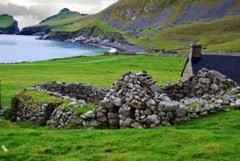 Humans and animals shared the houses built of stone and thatch; cleanliness was relatively unimportant then as you can understand, so to an outsider the smell was pretty terrible. The way of life was tough, but accepted as normal by the inhabitants whose happy and honest demeanour impressed the author.
  He writes about the history of the island, wondering why there should have been a fortified castle built on an island that was incredibly difficult to reach, far less land on. There is speculation too about the name of the island group there being no specific saint by the name of Kilda, but MacAuley gives his thoughts on the matter. (I read somewhere years ago that the words were derived from the Old Norse – sinta kelda – meaning fresh water and that the island was used as a watering hole by Scandinavian explorers in early centuries. As there are indeed several fresh water wells on the island that would make sense to me, but our Kenneth writes his own theories at great length).
 A very interesting book if you, like me, find islands, particularly this one, fascinating. I have for years now had a visit to St Kilda on my bucket list, something I fear will never happen now, it not being the easiest destination to reach, and I not as able or agile enough to get ashore. There are opportunities to get there, but if weather conditions are bad, which they often are, it is not always possible to get ashore, and I’m not sure I would be content with just seeing from afar.
  I’d want to land, and walk the village street,
imagine the inhabitants, at work or play,  see and explore the cleits or little stone store houses built scattered around the hillside.by long gone St Kildians, as they were known, but who we now call St Kildans. Take a look at this website for pictures and a short video of St Kilda. The houses you see today are of a more recent age than Kenneth would have known, though probably not Donald John. I think the houses of Kenneth’s day would have been more like the storehouse cleits, only bigger. Here’s a link to another website worth exploring.
Kenneth mentioned, from time to time, a writer of St Kildian history from the previous century, a medical man by the name of Martin Martin. He implied that Mr Martin’s writings were interesting but that his book was difficult to find, so I resigned myself to not being able to read it, and resolved to read again a book I read years ago –  The Life and Death of St Kilda, by Tom Steel, a more recent history of the island group, bringing the story up to date. The library didn’t have a copy but there was one in Kelso which they could have sent up to Peebles. However I opted to buy a kindle copy, and in looking it up on Amazon, what else should I see but
 Martin Martin’s A voyage to St Kilda, republished in 2011. So not only did I buy Tom Steel’s book but this one too. A Voyage to St Kilda has only eight chapters so is quickly read, and I found his style of writing to be much more entertaining than that of the two more learned gentlemen previously read. Martin’s book was written in 1697, and takes us back further into the mists of time, and more into the psyche of the people.
Martin, himself from one of the western isles of Scotland, begins his story with the disclosure that he has been careful to relate only what he himself experienced or that he was told by the St Kildans. He knows he can trust them with the truth as they were particularly unaware of lies and deceit. The Voyage to St Kilda begins with just that – the journey across the Atlantic Ocean from Harris in an open boat, through a storm, being blown off course, and finally following flocks of birds they reckoned were bound for St Kilda themselves. Then there was the difficulty of landing due to the heavy sea  and the problem of there being so many gannets – solan geese – flying above them. It took two days before the crew managed to row the boat into the bay.
From the start Martin found the St Kildians very friendly and hospitable. He observes their poor dwellings made of stone with a rough thatch having to be anchored by rope and stone weights to prevent the winds blowing the thatch away. He describes extremely well the village’s location and orientation, its weather, a little of its geology, and some history going back a further 100 years. Every subject that can be associated with the islands and its inhabitants has been well observed by Martin, and he writes clearly about his observations. To say that there was not much difference in the St Kildian way of life over two hundred years may not be surprising, but that is fact. The only unusual event was an earthquake in 1686 which shook the island for a few minutes, amazing and probably terrifying the population.
I enjoyed reading this book more than the other two mostly because it is simple and includes some humour. Martin is probably not a particularly learned fellow but is a keen and curious observer. 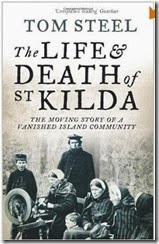 His writing style is easier, and very descriptive.
So my next read will bring the St Kilda story up to the 20th century. The Life and Death of St Kilda. Sad stuff ahead, but modern day living caught up with the island eventually.
Talk again soon.


